Introduction
Teaching someone to drive has always come with its challenges. Before the invention of dual control pedals, instructors had to rely on their voices, hand gestures, and nerves of steel. Today, dual control pedals are standard in driving school cars across the UK—but how did we get here? Let’s explore the fascinating history of dual controls and how they became essential for safe driver training.
Early Driving Instruction: A Risky Endeavour
In the early 20th century, when cars were becoming more accessible, driving instruction was informal. Friends, family, or mechanics often taught learners how to handle a vehicle. Without a way to take control of the car in emergencies, these lessons were risky for both the learner and the teacher.
The First Dual Control Systems
As driving tests became mandatory in the UK in 1935, the demand for safer instruction methods grew. Inventors began experimenting with secondary pedal systems, allowing instructors to brake when learners made mistakes. These early dual controls were mechanical linkages fitted to the brake pedal only—simple but effective.
Standardisation in the 1950s–1970s
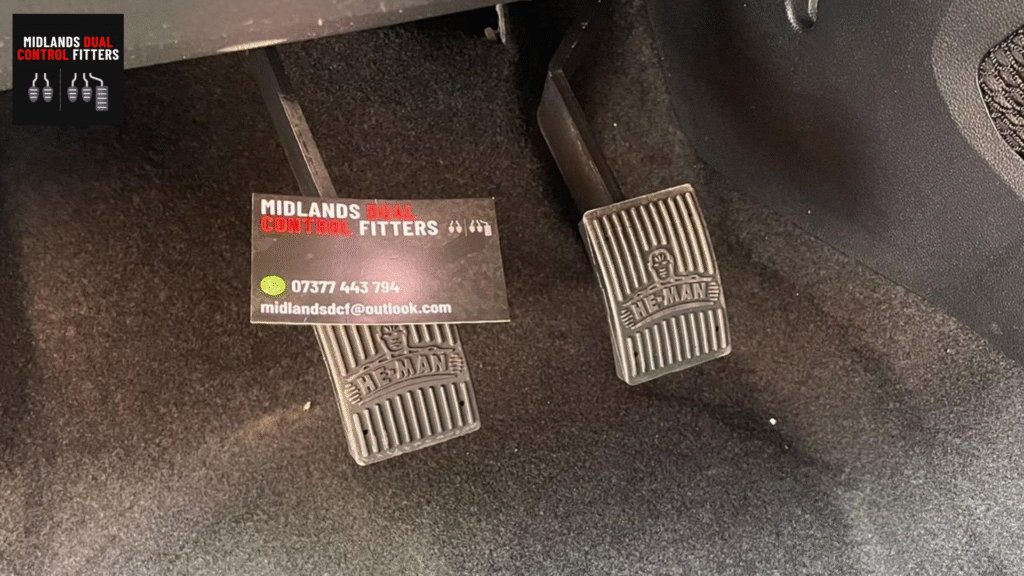
By the 1950s, professional driving schools had started adopting dual controls more widely. Companies like He-Man Dual Controls (founded in 1931) became pioneers in manufacturing reliable systems that could be installed across a range of vehicles. Their innovation brought consistent safety and made dual controls a recognised standard for driving instructors.
Modern Dual Controls
Today’s dual control pedals are designed to fit a wide variety of cars, including both manual and automatic vehicles. They are manufactured to meet DVSA safety requirements and installed by trained professionals. Modern systems are easy to remove when selling a vehicle, making them flexible for instructors.
Why the History Matters
The history of dual control pedals highlights one key point: safety has always been the priority. From the first mechanical linkages to today’s precise, vehicle-specific systems, dual controls have given both learners and instructors peace of mind.
Conclusion
Dual control pedals have transformed driving instruction, making lessons safer, more effective, and more professional. If you’re a driving instructor looking to equip your vehicle with the latest dual controls, our mobile fitting service ensures a safe and DVSA-compliant installation at your location.